01 — CONTEXT & INVESTMENT CHALLENGE
Seasonal Performance Problems Required More Than Equipment Replacement.
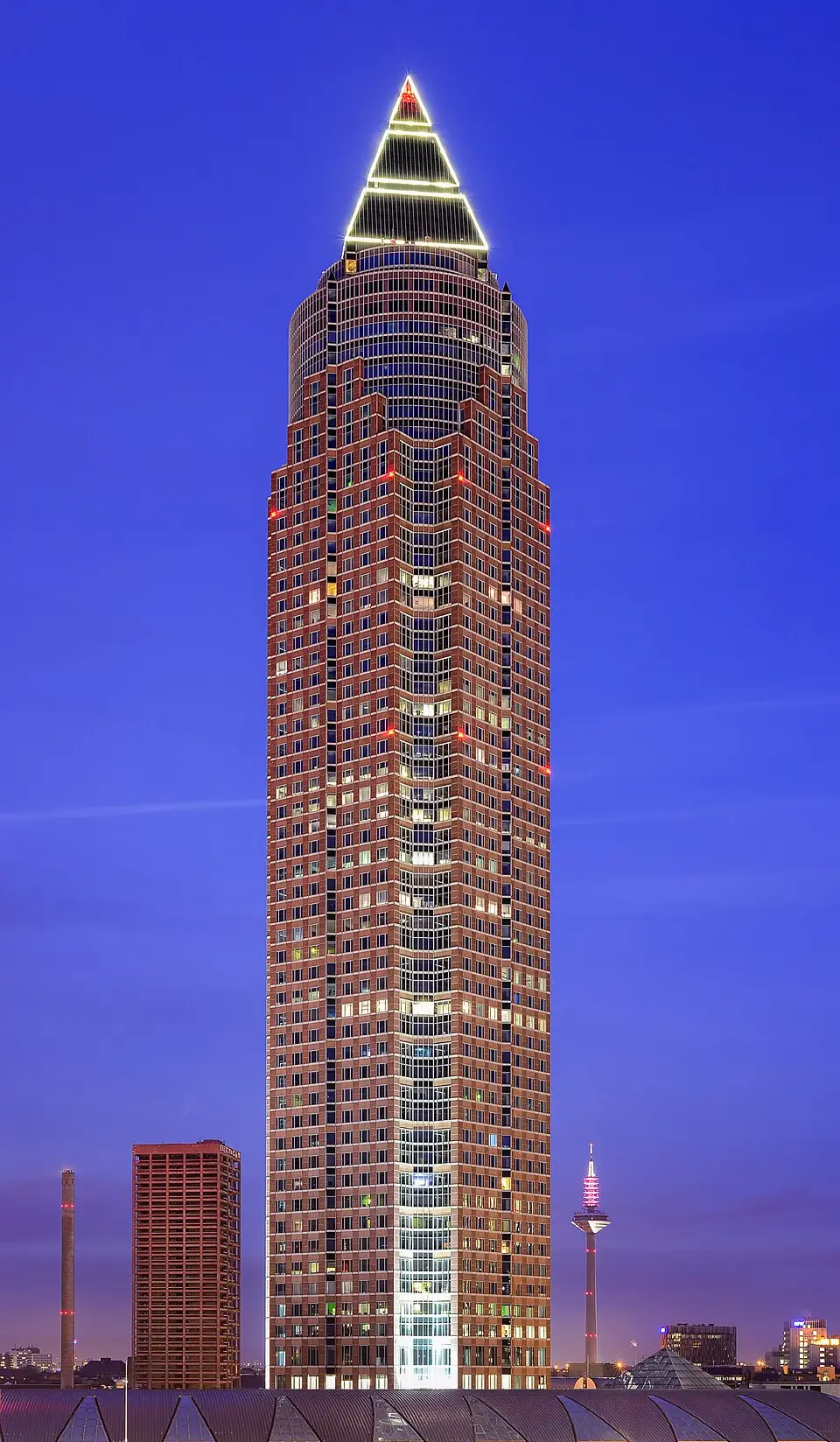
The Messeturm is one of Frankfurt’s landmark high-rise office buildings, operated by Messeturm Frankfurt GmbH. As a premium office asset, stable indoor climate conditions are important for tenant comfort and reliable building operation.
During the transition from spring to summer, the building experienced insufficient cooling performance combined with excessively dry indoor air.
The challenge was to identify the underlying cause within a complex HVAC system without assuming that additional equipment or major physical intervention was required.
02 — TECHNICAL SCOPE & KEY MEASURES
Understanding How the Existing HVAC System Was Actually Performing.
The technical investigation focused on the building’s main Air Handling Units and their interaction with the required indoor climate conditions.
The assessment combined on-site measurements, AHU performance analysis, evaluation of control strategies and operating parameters, and simulation-based calculations.
This identified deficiencies in the existing control and operating settings as the underlying cause of the seasonal cooling and humidity problems.
03 — INVESTMENT APPROACH
Optimising Existing Infrastructure Before Committing to Physical Intervention.
Rather than approaching the performance issue as an equipment problem, the assessment established whether the required indoor conditions could be achieved through the existing HVAC infrastructure.
Measured operating data and analytical calculations were used to define revised control settings aligned with the building’s actual cooling and humidity requirements.
The resulting approach focused intervention on the identified performance deficiencies rather than introducing unnecessary physical modifications.
04 — INVESTMENT CASE & OUTCOME
Restoring Indoor Conditions While Improving Energy Performance.
Implementation of the revised system settings restored the required indoor climate, providing adequate cooling while achieving balanced humidity conditions.
The optimisation eliminated the identified comfort problems and improved HVAC operating performance. It also reduced energy consumption without compromising the required indoor conditions.
The result was improved performance from the existing infrastructure without the need for a major equipment-based intervention.
05 — ROLE OF WINFRIED HAAS
Technical Investigation from Measurement to Set-Point Optmisation
Winfried Haas was responsible for the technical investigation of the HVAC performance issue, with particular focus on the main Air Handling Units.
His work included on-site measurements, performance analysis, assessment of control strategies and operating parameters, simulation-based analysis, identification of the underlying deficiencies and development of the optimised control settings subsequently implemented in the building.
06 — RELEVANCE FOR OWNERS TODAY
Diagnose Performance Before Investing in Additional Infrastructure.
Complex HVAC performance problems do not necessarily require additional equipment or capacity. Understanding actual system behaviour first can identify lower-capital interventions while protecting operational performance and energy efficiency.
FROM PROJECT EXPERIENCE TO OWNER-SIDE ADVISORY
This project predates the current HAAS Perspective advisory business and reflects Winfried Haas’s earlier technical and energy-efficiency experience. Today, HAAS Perspective provides independent owner-side advisory for major asset renewal and Net Zero transformation — from Investment Pathway evaluation through delivery assurance to performance validation.