
NET ZERO INVESTMENT PATHWAYS
The Right Net Zero Investment Pathway Is Not Always the Obvious One.
Energy efficiency and renewable energy are essential — but often insufficient to achieve Net Zero in existing buildings, and not necessarily the best long-term investment on their own.
Developing the right pathway requires looking beyond individual technologies and understanding how energy demand, system architecture and energy supply interact.
HAAS Perspective identifies, develops and evaluates alternative Net Zero Investment Pathways — combining technical expertise, lifecycle economics and investment analysis to help owners make informed capital decisions.
THE INVESTMENT CHALLENGE
Beyond Individual Technologies. Towards the Right Net Zero Investment.
✓ Maximising energy efficiency does not necessarily lead to the best investment outcome.
✓ Existing energy-system architectures may limit future decarbonisation options.
✓ Energy supply alternatives can fundamentally change investment economics.
✓ Decisions made today can create long-term technology lock-in.
The investment challenge is to evaluate these interdependencies — not individual solutions in isolation.
THE REMAINING GAP
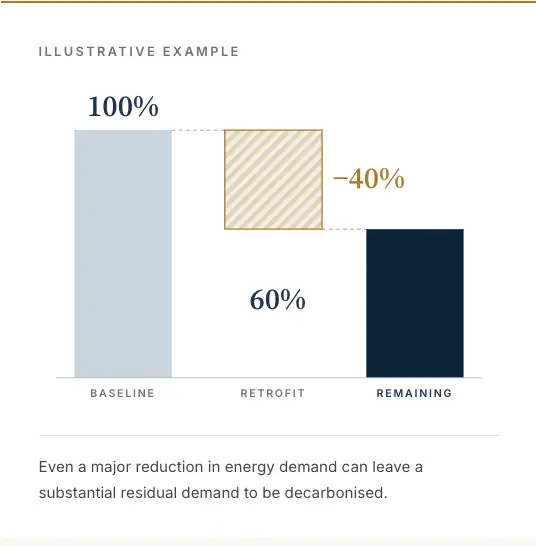
A Major Efficiency Retrofit Reduces Energy demand. But What About the Energy That Remains?
Major energy-efficiency retrofits can substantially reduce energy consumption, operating costs and emissions, with implemented UAE projects reporting energy savings of 20–40%.
But reducing energy demand is not the same as reaching Net Zero.
The strategic Question
How should the remaining energy demand be decarbonised — and at what cost, risk and timing?
The Net Zero Investment Pathway
From Retrofit to Net Zero.
A Net Zero Investment Pathway considers three interconnected investment dimensions.
REDUCE
retrofit
Reduce Energy Demand
Reduce the energy required by the asset through economically appropriate efficiency improvements.
Typical Measures
Chiller & HVAC, Controls & BMS, Pumps, Air Handling Units, Ventilators, VSD, Operational Optimization, Building Systems Renewal, Targeted Envelope Improvements.
Question
How far can energy demand be reduced economically?
RETHINK
Energy systems
Rethink How Energy Is Generated, Recovered and Transformed
Evaluate whether the cooling and energy-system architecture remains appropriate for the asset’s long-term pathway.
Typical Measures
Cooling Strategy, District-Cooling, Absorption Chiller, Heat Recovery, Cogeneration, Thermal Energy Storage, Integrated Energy Systems.
Question
Does the existing energy-system architecture remain appropriate for the long-term pathway?
RE-SOURCE
Energy Supply
Decarbonise Remaining Energy Demand
Evaluate how the remaining energy requirement can be supplied through renewable or other appropriate low-carbon energy sources.
Typical Measures
On-Site Solar, Off-Site Renewable Power, PPAs, Solar Thermal, Biogas, Renewable-Gas-ready Energy Systems
Question
How should the remaining energy requirement ultimately be supplied?
Closing the Net Zero gap may require more than improving existing systems — it may require rethinking the systems themselves.
WHY RETHINK MATTERS
Net Zero May Require Rethinking the Energy-System Architecture.
After economically appropriate demand reduction, a substantial residual energy demand may remain.
The question is then no longer only how efficiently individual systems operate, but whether the existing energy-system architecture remains appropriate for the asset’s long-term Net Zero pathway.
Energy recovery, thermal integration, storage or alternative cooling and energy-supply configurations may create opportunities that cannot be identified by optimising individual systems in isolation.
Reduce
Improves the existing System
RETHINK
Asks whether the existing system is the right one.
The question is therefore not simply what is technically possible — but which pathway best serves the owner’s objectives.
Re-Sourcing The Remaining Demand
Renewable Supply Is Part of the Pathway — Not the Pathway Itself.
Renewable energy can play a central role in decarbonising the remaining energy demand. But the amount that can be supplied — and under what conditions — depends on the asset, available space, generation and load profiles, infrastructure and energy markets.
On-site renewable generation may cover only part of the remaining demand. Off-site renewable supply can extend the available options, but introduces different considerations including availability, additionality, contractual structure, pricing, grid dependency and long-term risk.
Three interconnected dimensions of a Net Zero Investment Pathway.
Their relative importance depends on the asset. For some lower-energy assets, demand reduction and renewable supply may be sufficient. For complex, energy-intensive existing assets, all three dimensions may need to be addressed.
Together, they define the investment opportunity space to be considered when evaluating the long-term pathway of an asset.
The investment question is therefore not whether to choose retrofit, energy-system integration or renewable supply in isolation. It is how these opportunities should be combined and sequenced to create a robust long-term pathway for the asset..
Investment Lock-In
Today’s Retrofit Decision Can Shape Tomorrow’s Net Zero Pathway.
Major building systems investments can remain in place for decades.
Decisions made today can therefore determine which Net Zero pathways remain available tomorrow.
A major chiller or HVAC investment can deliver substantial energy savings, lower operating costs and an attractive investment return.
But it can also commit capital to an energy-system architecture that remains in place for many years.
Future opportunities for heat recovery, thermal storage, district cooling or other forms of system integration may depend on infrastructure decisions being made today.
A retrofit investment can be economically attractive today — and still constrain the asset’s Net Zero pathway tomorrow.
- TODAY’S INVESTMENT
- Chiller Replacement
- HVAC Renewal
- Cooling Infrastructure
- Long-term implications
- System Integration Options
- Infrastructure Flexibility
- Asset Value
- Net Zero Optionality
Don’t optimise today’s retrofit at the expense of tomorrow’s Net Zero pathway.
THE OWNER-SIDE PERSPECTIVE
The Owner Defines the Objective. The Asset and Economics Define the Pathway.
The Owner determines the ambition
What level of decarbonisation — and by when?
Available CAPEX · Target Payback / Return · Risk Appetite · Long-Term Asset Objectives
The Asset determines what is technically possible
What can realistically be achieved within the asset and its infrastructure?
Existing Systems · Energy Demand · Building Constraints · Infrastructure · Site Conditions
The Investment analysis determines what is economically robust
Which alternatives create a robust long-term investment case?
CAPEX & OPEX · Total Cost of Ownership · Returns · Carbon · Risk · Asset Value
Technology Neutral. Owner Side.
Compare Investment Pathways — Not Isolated Technologies.
Different technologies address different parts of the Net Zero challenge. Each may require specialist engineering, modelling or simulation.
But optimising individual technologies does not necessarily identify the best pathway for the asset as a whole.
A PV specialist optimises PV.
A district-cooling specialist optimises district cooling.
A trigeneration specialist may optimise trigeneration.
The owner needs comparison of Investment Pathways, not a collection of individually optimised technical solutions.
HAAS does not start with a preferred technology. We identify the pathways available to the asset, determine where specialist analysis is required, and integrate the resulting technical evidence into an owner-side investment decision.
Where specialist engineering, modelling or simulation is required, HAAS defines the scope of the required studies, supports the owner in selecting suitable specialist consultants and represents the owner throughout their evaluation.
Specialists develop the evidence.
HAAS integrates the evidence from the owner’s perspective.
FREQUENTLY ASKED QUESTIONS
Questions owners ask before engaging HAAS
What is Net Zero?
Net Zero means reducing greenhouse gas emissions as far as possible and balancing any unavoidable residual emissions with permanent carbon removals.
- At global and national level: Net Zero is the target behind the Paris Agreement’s goal of limiting global warming. Many countries have adopted national Net Zero commitments, including the UAE with its Net Zero by 2050 initiative.
- At building level: Net Zero typically refers to a highly energy-efficient building whose remaining energy demand is met by renewable or low-carbon energy. It can cover operational carbon only, or the building’s whole-life carbon including embodied carbon.
For real estate owners, Net Zero is not a single technical measure but a long-term transformation of the asset. HAAS Perspective translates it into concrete Net Zero Investment Pathways: which investments to make, in which sequence and at what point in the asset’s lifecycle.
Reaching Net Zero is the objective. Choosing the right pathway towards it is the investment decision.
What does Net Zero Operational Carbon mean?
Net Zero Operational Carbon means that the emissions from running a building are reduced to a level consistent with 1.5 °C pathways, with any residual emissions neutralised through carbon removals.
The World Green Building Council describes this as a highly energy-efficient building, powered by on-site and/or off-site renewable energy, with residual emissions neutralised. It sets out four guiding principles, which HAAS Perspective translates into investment terms:
- Reduce and optimise energy demand → REDUCE: How far should energy demand be reduced, and where does efficiency create the strongest owner value?
- Plan for deep decarbonisation → RETHINK: Does the existing energy system, including fossil-fuel equipment, remain appropriate for the asset’s long-term pathway?
- Supply remaining demand from renewables → RE-SOURCE: How should the remaining demand ultimately be supplied, on site or off site?
- Neutralise residual emissions: What remains, such as refrigerant leakage or unavoidable fuel use, and how can it be minimised before it is neutralised?
These principles define the destination. Which investments to make, in which sequence and at what cost is the decision the owner still has to make.
Source: World Green Building Council (https://worldgbc.org)
Does a Net Zero Investment Pathway require a building to achieve Net Zero Energy?
Not necessarily. Net Zero Energy and Net Zero Carbon are different objectives.
- Net Zero Energy: balancing a building’s annual energy consumption with renewable energy generated on site.
- Net Zero Carbon: reducing operational greenhouse gas emissions first, then supplying the remaining demand with credible low-carbon energy, on site or off site.
A Net Zero Investment Pathway is built around the owner’s defined energy, decarbonisation and compliance objectives. It evaluates how investments should be combined and sequenced across three dimensions: REDUCE the demand, RETHINK the system and RE-SOURCE the supply. If Net Zero Energy is the owner’s objective, the pathway is designed to reach it. If not, on-site generation is one option among several.
Every option is assessed against lifecycle economics, risk, timing and potential lock-ins, because the technical maximum is not necessarily the investment optimum.
What Are Scope 1, 2 and 3 Emissions, and Which Does HAAS Perspective Focus On?
HAAS Perspective focuses on the total operational carbon of the asset, whichever scope it falls into, and includes embodied carbon where investment decisions require it.
- Scope 1 – Direct emissions: from sources an organisation owns or controls, such as on-site fuel combustion and refrigerant leakage.
- Scope 2 – Indirect energy emissions: from purchased electricity, heating, steam or cooling, including district cooling.
- Scope 3 – Other indirect emissions: across the wider value chain, including tenant energy use in leased assets, building materials, equipment manufacturing and construction.
For real estate owners, the same building’s emissions can fall into different scopes depending on ownership, control and lease structure. Embodied carbon becomes part of the investment view whenever major retrofits or equipment replacement are considered. A replacement that lowers operational emissions is not automatically the better decision if its embodied carbon and lifecycle economics do not justify it.
Scope allocation matters because it determines which investments contribute to which decarbonisation, reporting and compliance objectives.
How is a Net Zero Investment Pathway developed?
A Net Zero Investment Pathway combines and sequences investments across three connected dimensions, aligned with the owner’s objectives and the asset’s renewal cycles.
- REDUCE – Demand: How far should energy demand be reduced?
- RETHINK – System: Does the existing energy system architecture remain appropriate for the asset’s long-term pathway?
- RE-SOURCE – Supply: How should the remaining energy demand ultimately be supplied?
The relevance of each dimension depends on the specific asset. It is not a rigid technical sequence. Timing is equally important: aligning investments with equipment end-of-life, planned refurbishments and lease events avoids premature replacement and stranded capital.
Alternative pathways are then compared across CAPEX, OPEX, lifecycle economics, returns, timing, risks, optionality and asset value. HAAS Perspective prepares the decision basis. The investment decision remains with the owner.
Does a Net Zero Investment Pathway have to be implemented all at once?
No. A Net Zero Investment Pathway is a long-term investment roadmap, not a single project.
- Near term: no-regret measures with strong economics or urgent technical need.
- Medium term: investments aligned with equipment end-of-life, planned refurbishments and lease events.
- Long term: system and supply transitions that depend on infrastructure, technology or market developments.
Staging allows capital to be deployed when it creates the most value. Decisions can be revisited as key assumptions change, such as energy prices, technology costs or infrastructure availability. What matters is that early investments do not block later steps.
A pathway sets the direction. Each investment step remains a decision of its own.