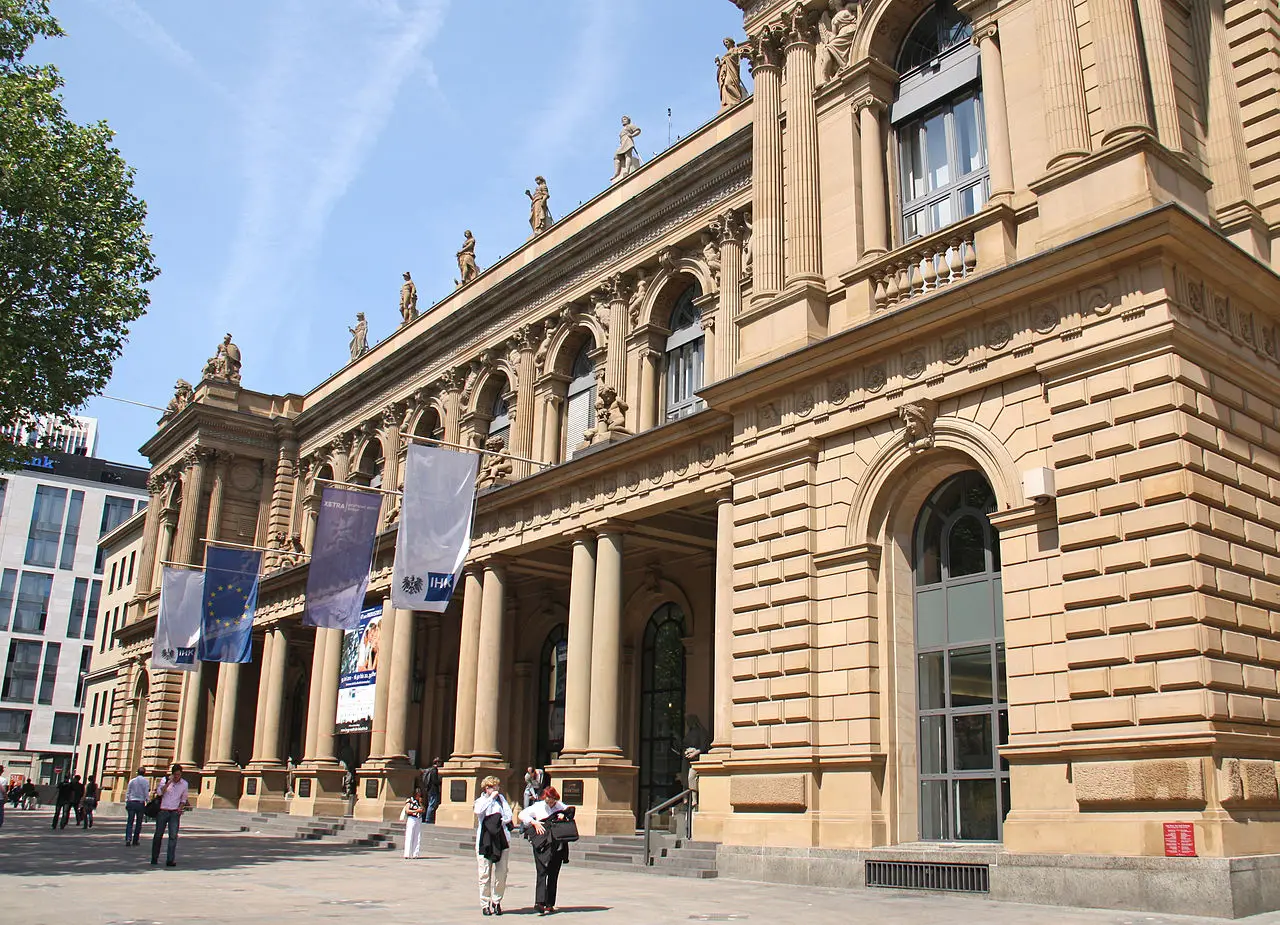
01 — CONTEXT & INVESTMENT CHALLENGE
Cooling Performance Had Become an Operational Risk.
Deutsche Börse AG operates critical financial-market infrastructure. Its Frankfurt facilities included highly sensitive trading environments where stable indoor conditions were essential to uninterrupted operations.
When cooling performance in the main trading floor became inadequate, indoor temperatures increased significantly. The resulting conditions required urgent investigation to identify why the existing cooling infrastructure was no longer delivering the required performance.
The challenge extended beyond an individual component. Cooling depended on the interaction between generation, thermal storage, distribution, controls and air-side systems.
02 — TECHNICAL SCOPE & KEY MEASURES
Diagnosing the Complete Cooling System, Not Individual Components.
The technical investigation addressed the cooling system as an integrated infrastructure.
The assessment focused on the Air Handling Units and their control logic, chiller operation and the existing ice-based Thermal Energy Storage system.
On-site measurements, system diagnostics and operational analysis identified critical deficiencies in the control strategy and interaction between cooling generation, storage and air-side delivery.
Immediate corrective measures and revised operating settings were then developed and implemented.
03 — INVESTMENT APPROACH
Restoring System Performance Before Considering Additional Infrastructure.
The analysis established whether the cooling problem resulted from insufficient physical infrastructure or from the way the existing systems were controlled and integrated.
This distinction was particularly important in a mission-critical environment. Adding cooling capacity without understanding the underlying system behaviour would not necessarily have addressed the actual cause.
The investigation therefore focused first on restoring the intended interaction between existing cooling generation, thermal storage and distribution infrastructure.
04 — INVESTMENT CASE & OUTCOME
Reliable Cooling Restored to the Trading Environment.
Correcting the identified control and operational deficiencies restored the required cooling performance within the main trading floor.
The intervention stabilised indoor conditions and improved coordination between chillers, ice-based Thermal Energy Storage and the air-side systems.
The result was restored performance and reliability of the existing integrated cooling infrastructure without an assumed requirement for additional cooling capacity.
05 — ROLE OF WINFRIED HAAS
Rapid Technical Diagnosis and Corrective Intervention.
Winfried Haas was responsible for the technical investigation and resolution of the cooling-performance problem.
His work included on-site measurements, cooling-system performance analysis, assessment of AHU control logic and chiller operation, functional analysis of the ice-based Thermal Energy Storage system, identification of control and integration deficiencies, and development of immediate corrective measures and system optimisation.
06 — RELEVANCE FOR OWNERS TODAY
Critical Infrastructure Problems Require System-Level Diagnosis.
Poor performance does not necessarily indicate insufficient infrastructure capacity. For interconnected cooling systems, understanding the interaction between generation, storage, controls and distribution can be essential before additional capital is committed.
FROM PROJECT EXPERIENCE TO OWNER-SIDE ADVISORY
This project predates the current HAAS Perspective advisory business and reflects Winfried Haas’s earlier technical and energy-infrastructure experience. Today, HAAS Perspective provides independent owner-side advisory for major asset renewal and Net Zero transformation — from Investment Pathway evaluation through delivery assurance to performance validation.